(P12) Incidence, prevalence, and clinical outcome of anaemia in inflammatory bowel disease: a population-based cohort study
Författare/Medförfattare
Sara Rundquist1, Carl Eriksson1, Ida Henriksson1, Ole Brus2, Yaroslava Zhulina1, Nils Nyhlin1, Curt Tysk1, Scott Montgomery2,3,4, Jonas Halfvarson1
Affiliates
1. Department of Gastroenterology, Faculty of Medicine and Health, Örebro University, SE-701 82, Örebro, Sweden. 2. Clinical Epidemiology and Biostatistics, School of Medical Sciences, Örebro University, SE-701 82, Örebro, Sweden. 3. Clinical Epidemiology Unit, Department of Medicine, Karolinska Institutet, SE-171 77, Stockholm, Sweden. 4. Department of Epidemiology and Public Health, University College London, WC1E 7HB, London, United Kingdom.
Abstract
Background: The incidence and short-term outcome of anaemia in inflammatory bowel disease (IBD) are largely unknown. Aims were to determine the incidence, prevalence, and clinical outcome of anaemia in terms of resolution of anaemia within 12 months. We also planned to assess risk factors for anaemia in IBD.
Methods: A random sample of 342 patients was obtained from the population-based IBD cohort of Örebro University Hospital, Sweden, consisting of 1,405 patients diagnosed between 1963 and 2010. Haemoglobin measurements recorded during 1 January 2011 to 31 December 2013 were extracted from the Clinical Chemistry data system.
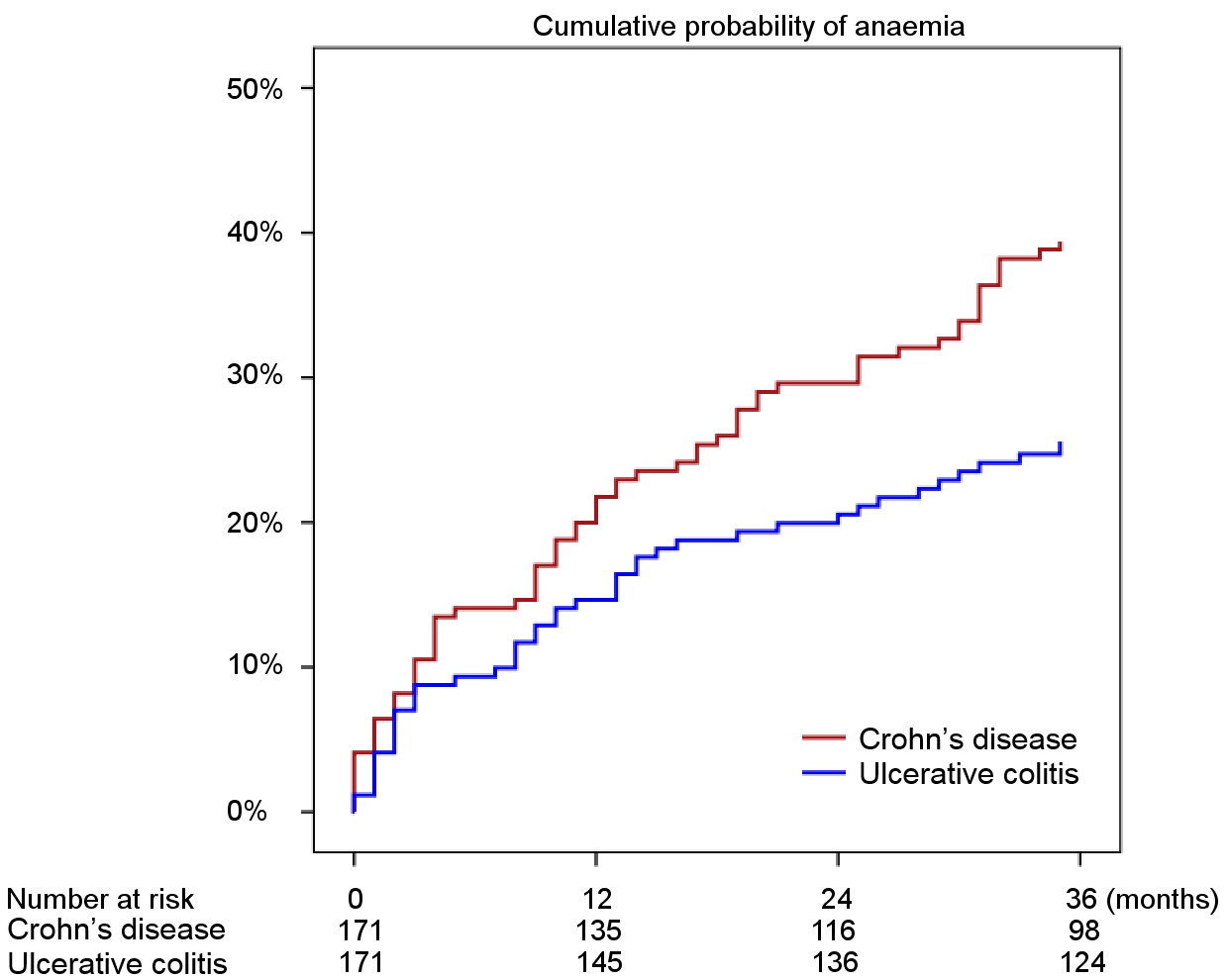
Results: In Crohn’s disease, the incidence rate of anaemia was 19.3 (95% CI: 15.4‒23.7) per 100 person-years and the prevalence was 28.7% (CI: 22.0‒36.2), compared with 12.9 (CI: 9.8‒16.5) and 16.5% (CI: 11.2 ‒22.9) for ulcerative colitis. Crohn’s disease was associated with an increased incidence (OR=1.60; CI: 1.02‒2.51) and prevalence of anaemia (OR=2.04; CI: 1.20‒3.46) compared to ulcerative colitis, Figure 1. Stricturing disease phenotype in Crohn’s disease (HR=2.59; CI: 1.00‒6.79) and extensive disease in ulcerative colitis (HR=2.40; CI: 1.10‒5.36) were associated with an increased risk of anaemia. Despite a higher probability of receiving specific therapy within 3 months from the diagnosis of anaemia, Crohn’s disease patients had a worse outcome in terms of resolution of anaemia within 12 months (56% vs. 75%; p=0.03).
Conclusion: Anaemia is a common manifestation of IBD even beyond the first years after diagnosis of IBD. Crohn’s disease is associated with both an increased risk and a worse outcome.
Reference: Eriksson C, Henriksson I, Brus O, et al. Incidence, prevalence and clinical outcome of anaemia in inflammatory bowel disease: a population-based cohort study. Alimentary pharmacology & therapeutics 2018;48(6):638-45. doi: 10.1111/apt.14920
Bifoga bilder